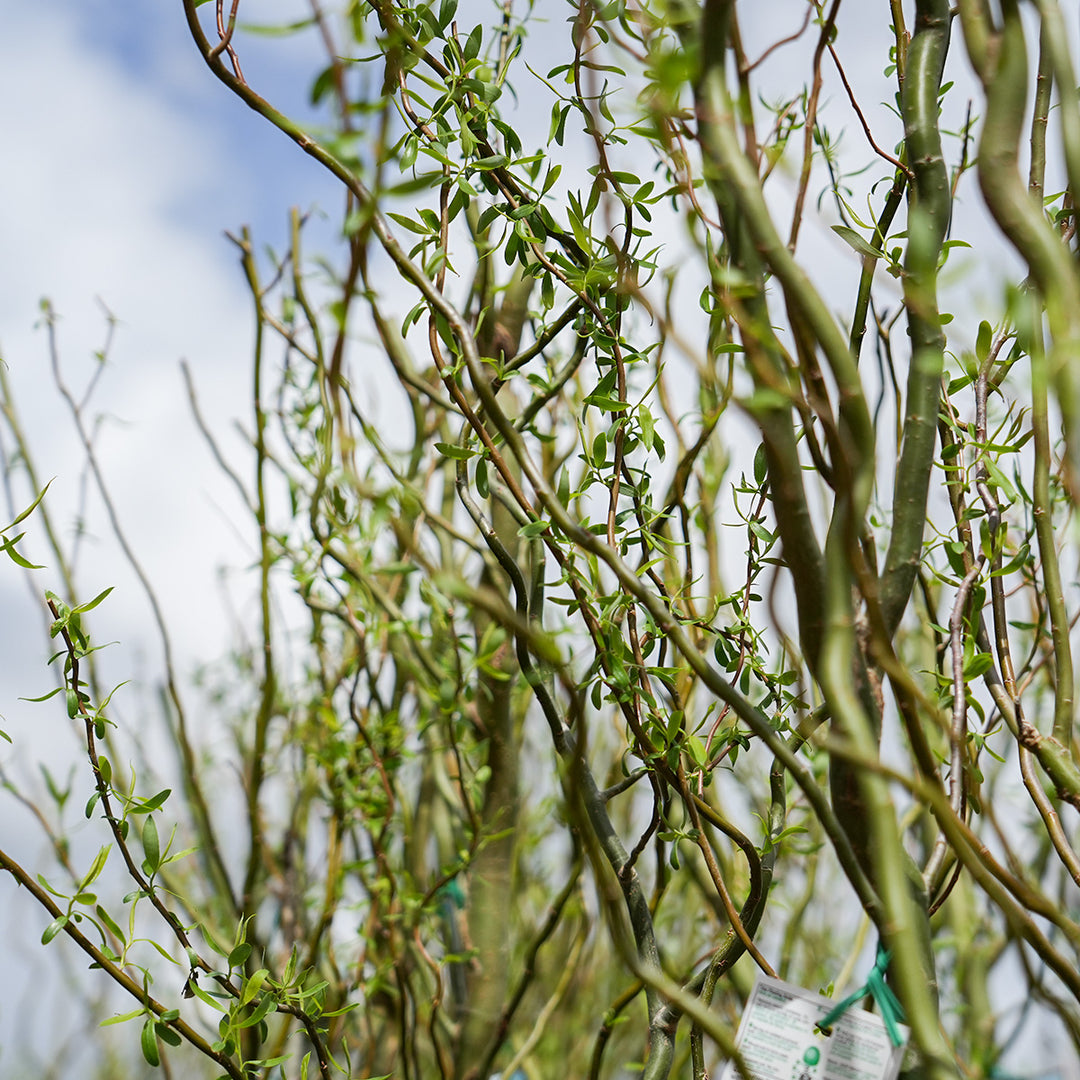
curly willow indoor plant Curly Corkscrew Willow Tree - 5-6 ft
SKU: 39190894184
curly willow indoor plant

curly willow indoor plant Curly Corkscrew Willow Tree - 5-6 ft

Sale price$24.78 Regular price$27.53
Save 10%

Shipping Estimate
USA
  • USA
  • CAN

Ships within 48 hours · Estimated delivery Jul 9 - Jul 14

Promo Codes Available:

For Your Every Summer RSVP, with Code: SUMMER15

Description

curly willow indoor plant Curly Corkscrew Willow Tree - 5-6 ftAdd Twisting Beauty and Fast Growing Shade with the Curly Corkscrew Willow Tree Curly Corkscrew Willow Tree Adds Visual Interest Year Round with Unique Twisted Branches Salix matsudana 'Tortuosa', as it is botanically named, is a species of willow tree. The Curly Corkscrew Willow Tree is a lovely addition to your landscape if you like unique and interesting trees that can provide street appeal, afternoon shade, & an unusual appearance for your

Add Twisting Beauty and Fast-Growing Shade with the Curly Corkscrew Willow Tree

Curly Corkscrew Willow Tree Adds Visual Interest Year-Round with Unique Twisted Branches

Salix matsudana 'Tortuosa', as it is botanically named, is a species of willow tree. The Curly Corkscrew Willow Tree is a lovely addition to your landscape if you like unique and interesting trees that can provide street appeal, afternoon shade, & an unusual appearance for your landscape. 

The Cork screw willow tree is native to China and Korea but has been naturalized in the United States to become a beautiful ornamental tree. 

Greenish yellow corkscrew willow leaves will emerge in spring as the weather warms up. The green leaves are slender, 4 inches long, and have white undersides that make peaceful noises when they rustle in the wind. 

When temperatures drop in the fall, the green leaves will turn to shades of golden yellow to put on a glorious fall color display. Corkscrew willow tortuosa is a deciduous tree so the leaves will fall during winter to go into a dormant state. 

The Corkscrew willow branches will twist and turn in all sorts of ways to give the tree its namesake. The twisted and curly branches have a whimsical look and will make the perfect addition to any cut floral arrangement.  

This one-of-a-kind Curly willow Corkscrew has weeping branches that give a nice shaded canopy once the pyramidal shape grows into its true form. This shade tree is an excellent choice to take a break under on a hot summer day.

The Chinese corkscrew willow salix has fuzzy yellow-green flowers in spring called catkins and eventually these yellow flowers mature into brown seedpods. Corkscrew willow cuttings are dried to use in cut flower bouquets, table arrangements, or centerpieces. They offer a modern look when paired with flowers and other green foliage. 

How to Care For a Corkscrew Willow Tree That You Bought Online

The corkscrew weeping willow tree is not picky on soil types and can adapt to most planting spots. They are even tolerant to salt spray and can be planted in coastal areas. Keep soil moist the first year of planting to establish a strong root system.

The corkscrew willow size is up to 20-40 feet tall and 15-30 feet wide at mature size. Plant in full sun or partial shade. 

Grow across the United States in USDA hardiness zones 4-8. Full-grown corkscrew willows are exceptionally cold hardy and can tolerate temperatures down to -20 F. 

How to Prune a Corkscrew Willow Tree

Prune corkscrew willow as needed to remove any dead, diseased, or crossed branches in late winter or early spring. You can also prune in late winter while the specimen tree is bare to collect the contorted branches for your floral projects. Hang upside down to dry until you are ready to get crafty!

The best pruning practice is to prune the twisted willow once a year to promote vigorous growing and a twisted branch structure.

Why Buy From Perfect Plants?

Perfect Plants has been growing healthy, vigorous trees on our family-run farm since 1980. With expert hands, premium care, and full Florida sun, every Curly Willow we ship is nurtured for success—ready to thrive in your landscape the moment it arrives.

Shop the corkscrew willow for sale today!

Shipping Notes
  • Free Standard Shipping on $100+ Orders to the USA.
  • Except Preorder products are shipped in 48 hours.
  • Delivery to the USA:
  1. Standard Shipping : 3-10 business days
  • If time is of the essence, please consider selecting expedited delivery for faster service.
Exchange/Return Notes
  • We offer a 30-day return/exchange service after receiving.
  • Final sale items are not eligible for returns or exchanges.
  • To process your return/exchange, please contact us at [email protected]
  • Please click here for more details>>> Return & Exchange Policy
SKU: 39190894184

Discover Niche Categories That Outsell curly willow indoor plant

Top-Converting Item to Boost Your Average Order

4.0 ★★★★★
Based on 2080 reviews
Sort
Highest Rating
Newest First
Oldest First
Product Reviews
K
Verified Purchase
Kristin B.
Whiting, US
★★★★★ 5
This Book is a Must-Read for All Parents!
I had been intrigued by for awhile and finally read it last year. I loved it and it made so much sense to me. My husband and I ended up discussing it for awhile and still do occasionally. We have five-year-old boy/girl twins and I felt it was important for me to read The 5 Love Languages of Children because I want my children to grow up securely, knowing they are truly loved. The 5 Love Languages of Children is written by Gary Chapman, author of The 5 Love Languages, and Ross Campbell, a psychiatrist who specialized in the parent-child relationship. If you've read The 5 Love Languages, you will recognize the same elements discussed in that book but this time, they apply to children, which is where Ross Campbell's expertise comes in to play. Since children are ever-changing and differ developmentally than adults, the concepts presented in this book are a great way to get to know your child better and hopefully have a more peaceful, loving household with children who grow up to be loving adults. This book is comprised of 223 pages and there is a chapter devoted solely to each love language. Then, there are chapters that discuss discipline and learning, along with the love languages. There is also a chapter to help you find your child's love language, although this can be difficult because children are constantly changing so it's definitely a great idea to learn how to speak all five to them! I'm so glad I read this and I wish I had read it sooner. My kids are still young and I think what I've just read can really help as they get older. I've been thinking about what their love languages could be and it's actually a bit difficult to pinpoint but now I've got the tools to help figure it out! If you are a parent, I strongly recommend reading this book. I'm glad I bought it so I can refer to it in the future. Even if you've read The 5 Love Languages, you'll want to read this one as well since there are differences between children and adults and the way they think. It's worth the time to read this book!
WAS THIS REVIEW HELPFUL?YesReportShare
Reviewed in the United States on February 3, 2018
A
Verified Purchase
Amazon Customer
Alexandria, US
★★★★★ 5
loved the book!
Format: Kindle
I agree that children are gifts and that they should be raised surrounded by love. It won’t happen without working on yourselves first. Great information and very interesting!
WAS THIS REVIEW HELPFUL?YesReportShare
Reviewed in the United States on March 5, 2026
N
Verified Purchase
Niki
Omaha, US
★★★★★ 5
Every parent should read this
What an eye opening book, not even just for how to understand the different ways to love your children, but on how people in general feel and express love differently. I firmly feel that every parent should be sent home with one of these books after having a baby. It has helped me understand things from my childhood and the lack of love I received, it has helped me understand my husbands love language and of course my sons. This book has revealed so much in so many different levels. It is any easy read and hooked me right away.
WAS THIS REVIEW HELPFUL?YesReportShare
Reviewed in the United States on January 26, 2025
M
Verified Purchase
M. Heiss
Louisville, US
★★★★★ 4
I'll admit I was skeptical
Ordinarily, the follow-on books are kind of flat. The Elizabeth George "After God's Own Heart" books seemed this way, although the first one, "A Woman After God's Own Heart" was excellent. I was expecting the same sort of flatness from this book. I found a lot to apply in the original Love Languages book, and I'm still sneaking it into my marriage. It's one thing to tell your Quality-Time husband that you are a TOUCH wife, and a whole different thing to gently convince him to touch touch touch touch touch touch. It has brought me to a whole new level of positive reinforcement. So I figured this one for kids would be a couple of hundred pages of telling parents that kids need *every* love language. And indeed, there was some of that. But the book was full of clues for how to recognize your child's love language, how it may change over time, and how to communicate. The book offered a lot. I thought the chapters on conflict were very worthwhile, and even on how to discipline in the different love languages. My kids are so different that I needed all the pointers I could get. And surprise -- thinking about love languages across generations has helped me communicate better with my parents, too -- off to a good start, anyway. I read this 6 months ago. My eldest started talking more, to me and to other people, NOTICEABLY more, and it's bringing me some relief from one of my biggest parenting worries -- how remote this child has been. That has been the biggest and most immediate change in our family recently, and I can trace it to this book. I would recommend you read the first Love Languages book first, and then this one to think specifically about your kids. Oh, and for moms, definitely read A Woman After God's Own Heart by Elizabeth George. It's family-enhancing.
WAS THIS REVIEW HELPFUL?YesReportShare
Reviewed in the United States on June 13, 2008
S
Verified Purchase
Seeker
Louisville, US
★★★★★ 5
You Love Your Child, But Does Your Child Feel Loved?
I rarely read a book from cover to cover twice, but when I was given the opportunity to receive a free copy of the 2012 Edition of The 5 Love Languages of Children by Gary Chapman and Ross Campbell for review, I was eager to do so, particularly since my daughter was so young the first time I read it that I could not determine her love language at the time. To be honest, even with the Love Language Mystery Game to help determine a child's love language, I still cannot be sure of my daughter's even though she is old enough that I should be able to do so. There is nothing wrong with the concepts described in the book, I think it is just that my daughter seems pretty balanced as she receives all five gratefully and gives all five as well, which I believe suggests that her father and I successfully have been keeping her "love tank" full most of the time. The book proposes that as loving as parents may try to be, a child may believe his parents love him, but may not feel loved because the parents are not speaking in the child's love language. While one child may be happy with a gift when the father comes home from a business trip, another child may not feel loved by getting a gift because his love language is quality time. This book helps parents to determine which of the five love languages--physical touch, words of affirmation, quality time, gifts, or acts of service--a child appreciates and needs the most as well as how the parent can help the child to feel loved. It also stresses that every child needs all five, but one will be predominate. I highly recommend this book for all parents, particularly those who are having difficulties with their children, but it is beneficial even to those who think they have happy, loving children. Probably just as important as understanding how to speak in the child's love language is how to discipline with love without causing damage to the parent-child relationship by using a type of punishment that empties the emotional tank; a chapter is devoted to this subject. If you are like me and have a 1997 Edition, let me explain the main differences I noticed between the two books, besides the change in the cover. The earlier edition often referred to keeping the emotional tank full would help to avoid drug use and teenage promiscuity, which was not in the latest edition. In the 2012 Edition, there were some updated statistics and reference to a book Battle Hymn of the Tiger Mother by Amy Chua that was published in January 2011. Some of the names in the stories had been changed to more popular names at the time of the rewrite. The most notable addition was the list of suggestions to speak the child's love language at the end of each corresponding chapter. Otherwise, there were only minor editing changes here and there. I did think that the hand print in the heart on the cover of the first edition was a better depiction than the green rubber boots with flowers, but that is a minor point. I received this book for free from Moody Publishers in exchange for my honest review.
WAS THIS REVIEW HELPFUL?YesReportShare
Reviewed in the United States on September 24, 2012

recommand products