Pay in installments of $7.20 with
 ,
,
 and
and

Shipping Estimate
USA
- USA
- CAN
- USA
- CAN
Ships within 48 hours · Estimated delivery Jul 5 - Jul 10
 Promo Codes Available:
For Your Every Summer RSVP, with Code: SUMMER15
Description
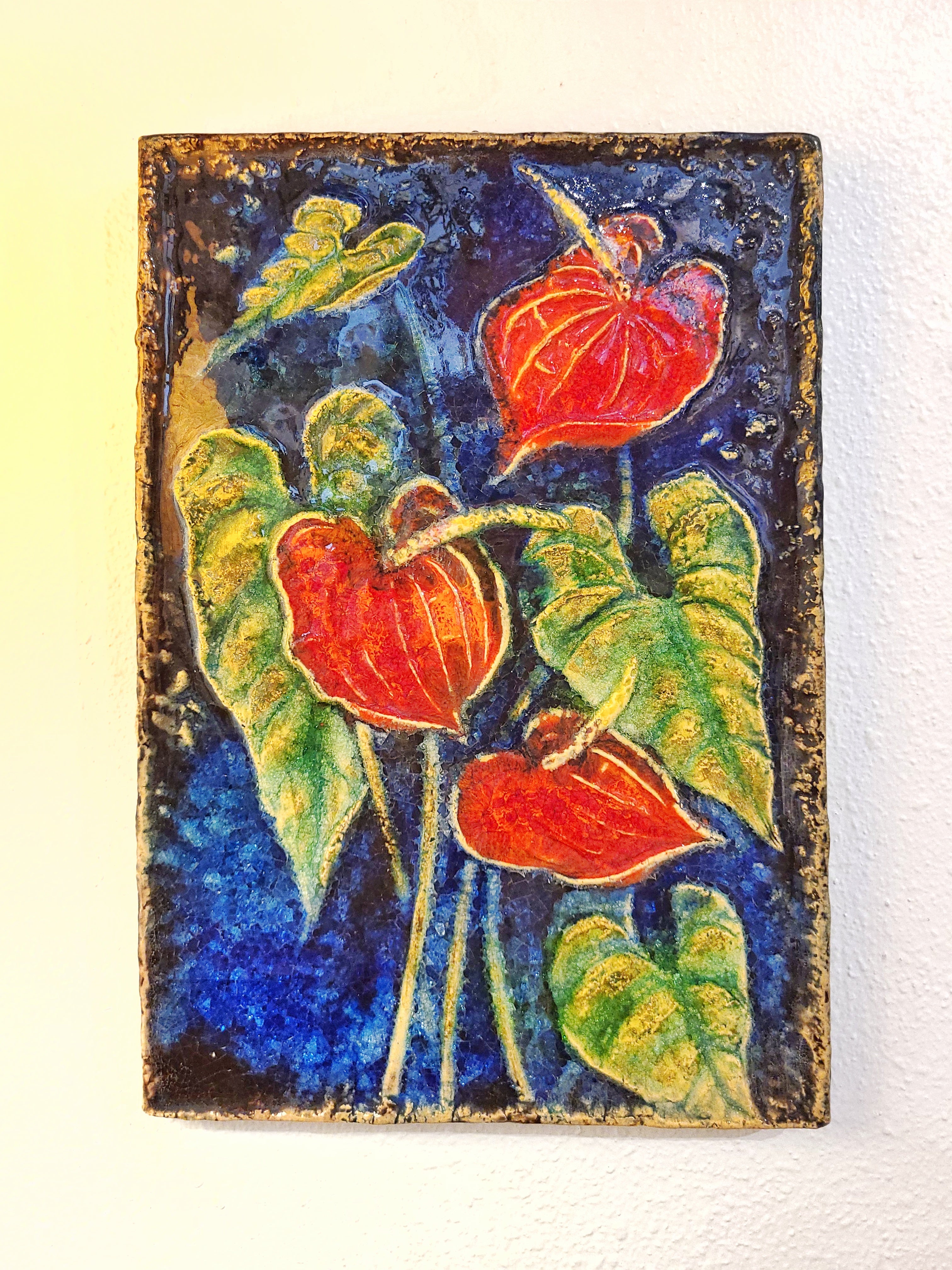
anthurium print 1950s WERNER MESCHEDE 'ANTHURIUM' WALL TILE Nr. 7513 FOR MAJOLIKA KARLSRUHE – MODERN REDUXA beautiful majolica Anthurium wall tile by Werner Meschede, designed as part of his series of botanicals for MAJOLIKA KARLSRUHE between 1966 and 1978. WERNER MESCHEDE (19251981) was one of the most significant majolica designers of the 20th century. Born in Stuttgart in 1925, he studied under the tutelage of the ceramic artist Max Lager (18641952) and began work as a potter in Schorndorf, a small town near Stuttgart, after WWII. In 1958, Meschede
A beautiful majolica ‘Anthurium’ wall tile by Werner Meschede, designed as part of his series of botanicals for MAJOLIKA KARLSRUHE between 1966 and 1978.
WERNER MESCHEDE (1925–1981) was one of the most significant majolica designers of the 20th century. Born in Stuttgart in 1925, he studied under the tutelage of the ceramic artist Max Laüger (1864–1952) and began work as a potter in Schorndorf, a small town near Stuttgart, after WWII. In 1958, Meschede received his master’s from the State Academy of Fine Arts Stuttgart. He was soon hired by MAJOLIKA KARLSRUHE, and for many years he served as its director of screen-printing, producing architectural and garden ceramics as well, both singularly and in series. Screen-printing on ceramics allows for the efficient, mass production of items with a high degree of precision and vibrant colors. Meschede is well known for his botanical series of majolica wall plaques and tiles, as well as numerous lava-glaze vases, “crackled” items, and plates. Specific designs featured among the botanicals included:
- Poppies (Mohn)
- Sunflowers (Sonnenblumen)
- Anthurium
- Kaiser’s Crown (Kaiserkrone)
- Snowdrops (Schneeglöckchen)
- Amaryllis
- King’s Lily (Königlilie)
MAJOLIKA KARLSRUHE (MANUFACTORY) was established in 1901 by Grand Duke Friedrich I of Baden (1826–1907), at the behest of its founders, artists Wilhelm Süs (1861–1933) and Hans Thoma (1839–1924). An “idyllic” spot was chosen in the Duke’s residential city, near the palace gardens, the nexus of princely power and artistic production—a connection immortalized for the plant’s 2001 centennial by the installation of a “blue ray” (Blauer Strahl in German), a path of blue majolica tiles, physically linking the palace tower to the factory.
Süs and Thoma sought to revive the “majolica,” or faience technique, where “tin” glaze is applied to earthenware and used as a canvas for intricate colored decoration. The glaze, in reality, is a lead one, rendered white and opaque with the addition of tin oxide. Majolica’s manufacture involves dipping items in the white glaze, allowing it to dry, and then painting on designs before a second, high-temperature firing. The initial focus was on producing ceramics in the Italian Renaissance style, a choice influenced by their shared background and Süs’s prior experience running a ceramics studio. Towards the end of the decade, a signature style emerged—elaborate compositions, often including cherubim, on blue backgrounds. Eventually, MAJOLIKA KARLSRUHE would become a mirror for 20th-century artistic movements, from Art Nouveau to Bauhaus.
A note on terminology: What is referred to here as “majolica,” after the German usage, is often called “maiolica” in English, to distinguish it from the Victorian-era, mass-produced earthenware that uses a clear, colored lead glaze applied over a molded relief body, fired only once. The confusion associated with these naming conventions is long-standing!
Following revolutionary unrest at the end of WWI, popular demands for the establishment of a republic forced Grand Duke Friedrich II to abdicate, a peaceful transition and a pattern seen across all other German states. With the establishment of the Weimar Republic in 1918, the new Republic of Baden took over former royal properties, including MAJOLICA KARLSRUHE. The formal name Staatliche Majolika Manufaktur Karlsruhe was adopted in 1927 to indicate state ownership.
Despite the specificity of its name, MAJOLIKA KARLSRUHE produced a wide range of artisan ceramics and was one of Germany’s leading ceramic producers generally. The quality of its work was excellent. Top designers before WWII included Ludwig König (1891–1974) and Max Läuger (1864–1952).
The factory was badly damaged by bombs in 1944 and did not return to the full-time production of decorative goods until the 1950s. By then, business had resumed much as in pre-war days, with both company-employed and freelance designers. One of the foremost post-war designers was Fridegart Glatzle (1920–2015), who joined MAJOLIKA KARLSRUHE in 1951. Over the next 30 years, she produced a huge range of designs; much of her work is highly collectible. Other designers of this period included luminaries Eva Fritz-Lindner (1933–2017) and Werner Meschede (1925–1981). The company provided its artists with their own studio space, commissioning their activity.
Most MAJOLIKA KARLSRUHE pieces bear the company’s name and symbol—the arms of Baden above a double-joined ‘M’ for Majolika-Manufaktur. Items are marked with a form number and, with exceptions in the late 20th, were made with red-orange clay. Product examples can be seen at the Badisches Landesmuseum in Karlsruhe.
The commercial production side of MAJOLIKA KARLSRUHE officially concluded its 123-year operating history at the end of 2024, with its final collection dispersed at a historic closing auction in early 2025. The site now primarily functions as a museum, hosting a foundation for the promotion of the ceramic arts.
| Designer | WERNER MESCHEDE |
|---|---|
| Manufacturer | Karlsruher Majolika |
| Design Period | 1960 to 1969 |
| Year of Production | |
| Production Period | 1970 to 1979 |
| Country of Manufacture | Germany |
| Identifying Marks | This piece has an attribution mark |
| Style | Vintage, Mid-Century, Modernist |
| Detailed Condition | Excellent — This vintage piece is in near original condition. It may show minimal traces of use and/or have slight restorations. |
| Product Code | CRM-730777 |
| Materials | Ceramic, Stoneware |
| Color | Blue, green, red, yellow |
| Width | 28 cm 11 inch |
| Depth | 3 cm 1 inch |
| Height | 41 cm 16 inch |
Shipping Notes
- Free Standard Shipping on $100+ Orders to the USA.
- Except Preorder products are shipped in 48 hours.
- Delivery to the USA:
- Standard Shipping : 3-10 business days
- If time is of the essence, please consider selecting expedited delivery for faster service.
Exchange/Return Notes
- We offer a 30-day return/exchange service after receiving.
- Final sale items are not eligible for returns or exchanges.
- To process your return/exchange, please contact us at [email protected]
- Please click here for more details>>> Return & Exchange Policy