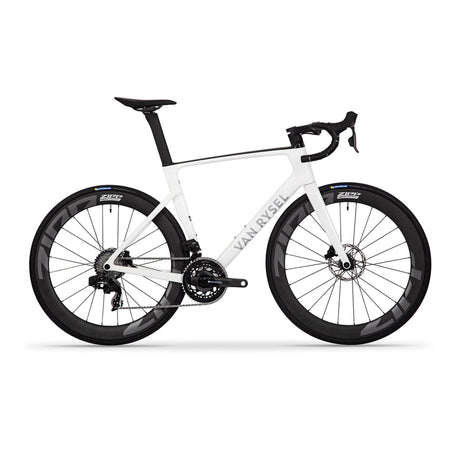
van rysel rennrad 2023 Van Rysel RCR-X Tri Ultegra Di2 Triathlon Bike
SKU: 27544270463
van rysel rennrad 2023

van rysel rennrad 2023 Van Rysel RCR-X Tri Ultegra Di2 Triathlon Bike

Sale price$20.25 Regular price$22.50
Save 10%

Pay in installments of $5.62 with ShopPay, AfterPay and Klarna

Shipping Estimate
USA
  • USA
  • CAN

Ships within 48 hours · Estimated delivery Jul 5 - Jul 10

Promo Codes Available:

For Your Every Summer RSVP, with Code: SUMMER15

Description

van rysel rennrad 2023 Van Rysel RCR-X Tri Ultegra Di2 Triathlon BikeThe Van Rysel RCR X Tri Ultegra Di2 Bike is Van Rysel's first dedicated triathlon platform, and the development story behind it sets appropriate expectations. Built in collaboration with Swiss Side the aerodynamic engineering firm behind some of the most wind tunnel validated equipment in professional cycling the RCR X Tri progressed through 14 prototypes before reaching production. Two time European Ironman champion Denis Chevrot contributed to the

The Van Rysel RCR-X Tri Ultegra Di2 Bike is Van Rysel's first dedicated triathlon platform, and the development story behind it sets appropriate expectations. Built in collaboration with Swiss Side — the aerodynamic engineering firm behind some of the most wind-tunnel-validated equipment in professional cycling — the RCR-X Tri progressed through 14 prototypes before reaching production. Two-time European Ironman champion Denis Chevrot contributed to the design process. At $8,499, the resulting bike ships with Swiss Side Hadron² wheels, Shimano Ultegra Di2 shifting, Dura-Ace TT levers, an integrated power meter, and a purpose-built nutrition and storage system — a specification that consistently outpaces what competing brands offer at this price point.

The frame is 100% high-modulus carbon fiber, developed with stiffness targets that reflect the specific demands of long-distance triathlon. Measured stiffness is 225 N/mm at the bottom bracket and 151 N/mm at the head tube — figures that translate to efficient power transfer during sustained efforts and stability in the aero position over Ironman-length distances. The RCR-X Carbon fork was refined through the same CFD and wind tunnel development as the frame itself. In head-to-head wind tunnel testing at 45 km/h, the XCR Tri saved 3.4 watts compared to the fastest competing triathlon bike tested when both ran 80mm front and rear wheels — a margin that accumulates meaningfully across a 180-kilometer bike leg.

Geometry is designed around the demands of long-course triathlon racing. A 79° seat tube angle positions the rider aggressively over the pedals — loading the posterior chain efficiently for power output while preserving the hip flexors for the run. Reach measurements of 380mm (XS) to 444mm (XL) paired with low stack heights place the rider in a competitive aero extension without requiring extreme flexibility. The Van Rysel carbon aerobar and base bar system provides meaningful stack and reach adjustability via spacers, and the two-screw platform attachment simplifies disassembly for travel.

The drivetrain is a deliberate mixed specification. Shimano Dura-Ace R9180 TT/tri levers handle shifting from the aero extensions — the top-tier choice for triathlon ergonomics and tactile precision — while Shimano Ultegra Di2 R8150 derailleurs manage the 52/36 chainrings and 11-34T 12-speed cassette. The Shimano Ultegra R8100 crankset includes an integrated power meter, a tool central to pacing long-course triathlon and typically an additional purchase at this price level. Shimano Ultegra R8170 hydraulic disc brakes handle stopping front and rear.

The wheel specification is among the most compelling aspects of this build. Swiss Side Hadron² Ultimate wheels ship with the bike — a 625 (62.5mm depth) at the front for crosswind manageability and an 800 (80mm depth) at the rear for maximum aerodynamic efficiency. This asymmetric pairing is the same strategy used by professional triathletes at championship distances. Continental Aero 111 TLR 700x26 runs up front; Continental Grand Prix 5000 S TR 700x28 at the rear — a tire combination optimized for both rolling resistance and aerodynamics. The frame's integrated storage system covers race-day nutrition logistics: a bento box holds up to six gels, a toolbox above the bottom bracket stows a flat repair kit, a trash box handles wrapper disposal, and two bottle mounts position hydration between the aerobars and behind the saddle.

Design Benefits

  1. Swiss Side co-development across 14 prototypes: CFD and wind tunnel refinement delivered a verified 3.4-watt aerodynamic advantage over the fastest competing triathlon bike tested at 45 km/h — a margin that compounds over long-course race distances.
  2. High-modulus carbon stiffness targets: 225 N/mm at the bottom bracket and 151 N/mm at the head tube translate sustained power efficiently and keep the front end stable during deep-position efforts at race speed.
  3. Asymmetric Swiss Side Hadron² wheel pairing: 62.5mm front and 80mm rear depths balance crosswind stability with maximum aerodynamic efficiency — the same wheel strategy used by professional triathletes at championship distances.
  4. Integrated power meter included: The Shimano Ultegra R8100 crankset ships with a built-in power meter — essential for long-course pacing and included in the base build at no additional cost.
  5. Purpose-built race-day storage: Bento box, toolbox, trash box, and two bottle mounts are integrated into the frame, eliminating aerodynamically costly external add-ons while covering nutrition and mechanical needs for six-plus hours of racing.

Final Take

The Van Rysel RCR-X Tri Ultegra Di2 is one of the most completely specified triathlon bikes at this price. Swiss Side race wheels, an integrated power meter, hydraulic disc brakes, and a full race-day storage system are typically separate purchases on competing bikes in this category — here they're part of the standard build. For athletes targeting their first long-course race or upgrading from an entry-level triathlon platform, the RCR-X Tri delivers serious hardware without requiring a second round of component investment after purchase.

Shipping Notes
  • Free Standard Shipping on $100+ Orders to the USA.
  • Except Preorder products are shipped in 48 hours.
  • Delivery to the USA:
  1. Standard Shipping : 3-10 business days
  • If time is of the essence, please consider selecting expedited delivery for faster service.
Exchange/Return Notes
  • We offer a 30-day return/exchange service after receiving.
  • Final sale items are not eligible for returns or exchanges.
  • To process your return/exchange, please contact us at [email protected]
  • Please click here for more details>>> Return & Exchange Policy
SKU: 27544270463

Discover Niche Categories That Outsell van rysel rennrad 2023

Top-Converting Item to Boost Your Average Order

4.4 ★★★★★
Based on 1799 reviews
Sort
Highest Rating
Newest First
Oldest First
Product Reviews
A
Verified Purchase
arch_reviews
Massapequa, US
★★★★★ 4
A Cheeky Novel about writing cheeky novels
Format: Paperback
Wired for Story is a book full of solid, albeit basic, advice for story tellers, and in particular writers trying to develop their craft. It succeeds in some areas while falls down in others, however I found it solid and well written overall. Where it succeeds is in its brevity and clarity. The author gets right to the point and even provides short lists at times of what to do and how to do it. Her writing is also peppered with cheeky humor which is humorous in a thats-almost-funny kind of way that is refreshing compared to the textbook style adopted by many how-to-write books. Where the book fell down, for me, was in its limited examples and scope. It really felt like the author was addressing romance writers, for the most part. I could think of a few counter examples to some of her rules, although one would have to leave the romance genre for those to work. But for a 230 page book, that is minor discrepancy. The second thing I noticed, which has already been pointed out by others, is that the brain science was limited. In fact, it was mostly only refereed to in footnote. Personally, that was fine with me, but I could see why it made others feel misled (it is in the title, after all).
WAS THIS REVIEW HELPFUL?YesReportShare
Reviewed in the United States on December 5, 2014
M
Verified Purchase
Martijn13Maart1970
Waukegan, US
★★★★★ 5
Unfortunately yet another one to add on the pile of writing books!
Format: Paperback
I say 'unfortunately another good book on writing' since I have been reading many books on the topic and each time I think I have read it all by now, pfff, but then another one like this comes along. But hey, it is fun to read about writing and especially if you get something useful and new out of it. Always worth the money. Why the accolades for this book? All the information on characters, plot, details etc, how they work and why they are important, is not new. You find them in many reading books, especially from Reader's and Writer's Digest series. I would especially recommend the books on plot and structure by James Scott Bell. Yet this book Wired For Story is not redundant, since it is unique in both the focus on the familiar subjects like what story is, the importance of details, details versus generics, how events affect a character etc. The approach of using brain science shows in a compelling way why all the stuff in the book (and for that matter, the classic theory on writing) is there for a reason, since it has evolved out of how we humans seem to perceive a story. Interesting though, a lot of rules like 'write about what you know' are shown to be myths. Of course, in the end it is you as a reader that has to decide what works for you, but you will find new things here and that is always good. If you are thinking about writing a story, this book can give you a very sharp focus on what to think about before you start. Or, like me, when you have a draft, and you want to get to the 'real story' behind it to come forward, this work gives you a very transparent way to get better clues as to what stays and what has to go. It is also entertaining and easy to read, so, all I can say is, yet again a book on writing you cannot afford to miss! I just added some extra information: I loved the humor and wisdom of the writer. She has worked for years reading manuscripts and she does know her stuff, and I liked her tone, which was both realistic but also fun! How many times have you read a reference work and actually had to laugh? But this book was also profound on many story issues. Many common writing rules are, as I said before, shown to be myths and more importantly, why this is so. I have read for instance so often that you should have some sensory info on every page, but, as I thought myself and I am not the only one: although this makes things more lively, it should only be there if the story would dictate it! The book has many more things like these. I have compiled a collection of notes I took from all the many many books on writing so I measure new books on writing in how much text I copied and pasted to look at again and this book has given me lots, so 5 stars and I hope we will see more of this author again! I also recommend the book by James Scott Bell on plot and structure which you can find here
WAS THIS REVIEW HELPFUL?YesReportShare
Reviewed in the United States on October 28, 2012
C
Verified Purchase
C. F. King
Pawtucket, US
★★★★★ 5
Great book
Format: Kindle
I have been an author for decades and published 4 books. I've been an editor for over a decade and this book is perfect for seasoned and new writers. It certainly made me take a new, long look at the latest book I'm busy with. I think it's great for getting one focused on the important points. I loved it. There wasn't too much about how the brain works to bore one or make it feel like a technical book on neuroscience. I found her writing style amusing and entertaining. I will definitely recommend it to all my clients and writing friends. There was nothing in the book I didn't know, but this book forces one to focus on the bigger picture. It doesn't matter how accomplished one is as a writer, one can always learn more. And I certainly did with this book. So, thank you, Ms. Cron. I saw the negative three or fewer star comments and can only think the commentators didn't see what the author was actually trying to convey. It's a classic lesson in the KISS method (keep it simple stupid) and I loved it. This isn't a full-on, in-depth analysis of every part of the craft of writing, as many seemed to expect, that would take 12 full books or more. This is also not only for beginners as some suggest. To them I would say, don't let hubris cloud your ability to write better--think beyond that--read the book again. I think the book serves as an excellent reference to keep us on track when we lose the plot, so to speak. Seasoned writers can get quite jaded and write almost on auto-pilot at times--not good. Thank you, Ms. Cron, for putting me back on track and making me excited to re-write and re-edit my latest book, my first YA fantasy, for the zillionth time. I was out of my comfort zone with this book and feeling a bit overwhelmed and unsure. Wired for Story has me fired up to go forth and do this. I highly recommend this book, especially for seasoned writers.
WAS THIS REVIEW HELPFUL?YesReportShare
Reviewed in the United States on January 26, 2018
R
Verified Purchase
robert lanier
Houston, US
★★★★★ 5
Quality writing information
Format: Paperback
A book that was fun to read and informative. I feel as though I have a better understanding of writing fiction now.
WAS THIS REVIEW HELPFUL?YesReportShare
Reviewed in the United States on February 11, 2026
R
Verified Purchase
Ron Mahon
Massapequa, US
★★★★★ 5
Thanks to a great new book ”Wired for story
Format: Kindle
I’ve written many books over the years, and published 40 or so. Once I started writing my first novel, I found out that all the old techniques just didn’t work. Thanks to a great new book ”Wired for story. The writer’s guide to using brain science. By Lisa Cron” Lisa studied and cataloged the works of several Neuro scientists. She explained all of that, plus how it applied to writing a novel. Better yet, she then shows us how to apply these techniques to where it counts. In addition, This changes the hierarchy of your novel. Ensuring that it’s focusing on what’s important to the brain. Using this new brain science, she proposes a completely new hierarchy of needs for your book. Moreover, the fact that the brain is trying to solve the problem of the protagonist. • “What happens” is the plot • “Someone” is the protagonist • The “goal” is what’s known as the story question • “How are he or she changes” is what the story itself is actually about. As counterintuitive as it may sound, the story is not about the plot or even what happens in it. Stories are about how we, rather than the world around us, change. The more your reader discovers the missing pieces to solving the protagonist's problem the more interesting if it is. It seems as the mind creates a mental stimulation of events described in the story. But he goes much deeper than that Details about actions and sensations that are captured from the text and integrated with personal knowledge from past experiences these data are then run through mental stimulation using brain regions a closely mirror those involved when people perform, imagine, or observe similar real-world activities. Haven’t you ever come home from a movie, reenacting that movie in your own mind? When the events of the story of filtering through the protagonist's point of view, allowing us to watch as she makes sense of everything. Seeing it in her eyes. This is not just like we see things. It’s that we grasp what they mean to her. Other words the reader must be aware of the protagonist personal effect on everything that happens. This is exactly where I fell apart on my novel is should be a first person third person. Lisa explains all these points of view, their advantages, and their disadvantages… My personal choices third person, omniscient. It also fixes another problem about tags. This technique is so powerful the third person doesn’t have to be bothered with he said;​ she said it’s so intuitive, it needs no explanation. It also settles a big dispute that I’ve always had the use of italic, quotes, and indented text. None are necessary. Some of the best examples that I’ve ever seen for show rather than tell. All the points that the author makes are demonstrated and explained with real examples from published articles. It’s like a five-year writing course that you can complete in three or four days. I bookmarked it extensively so that I can get back to those important points. Neuroscience also explains why social proof works so well. And a few hints on how to customize it, for your particular problem or opportunity. As a copywriter, one who writes advertising copy? I have long been aware of how to write directly to the subconscious mind. These techniques have been known for almost 100 years. We just didn’t know why they worked. Only that they did work. Thanks to Lisa for this fantastic book, I now know why they work.
WAS THIS REVIEW HELPFUL?YesReportShare
Reviewed in the United States on April 19, 2015

recommand products