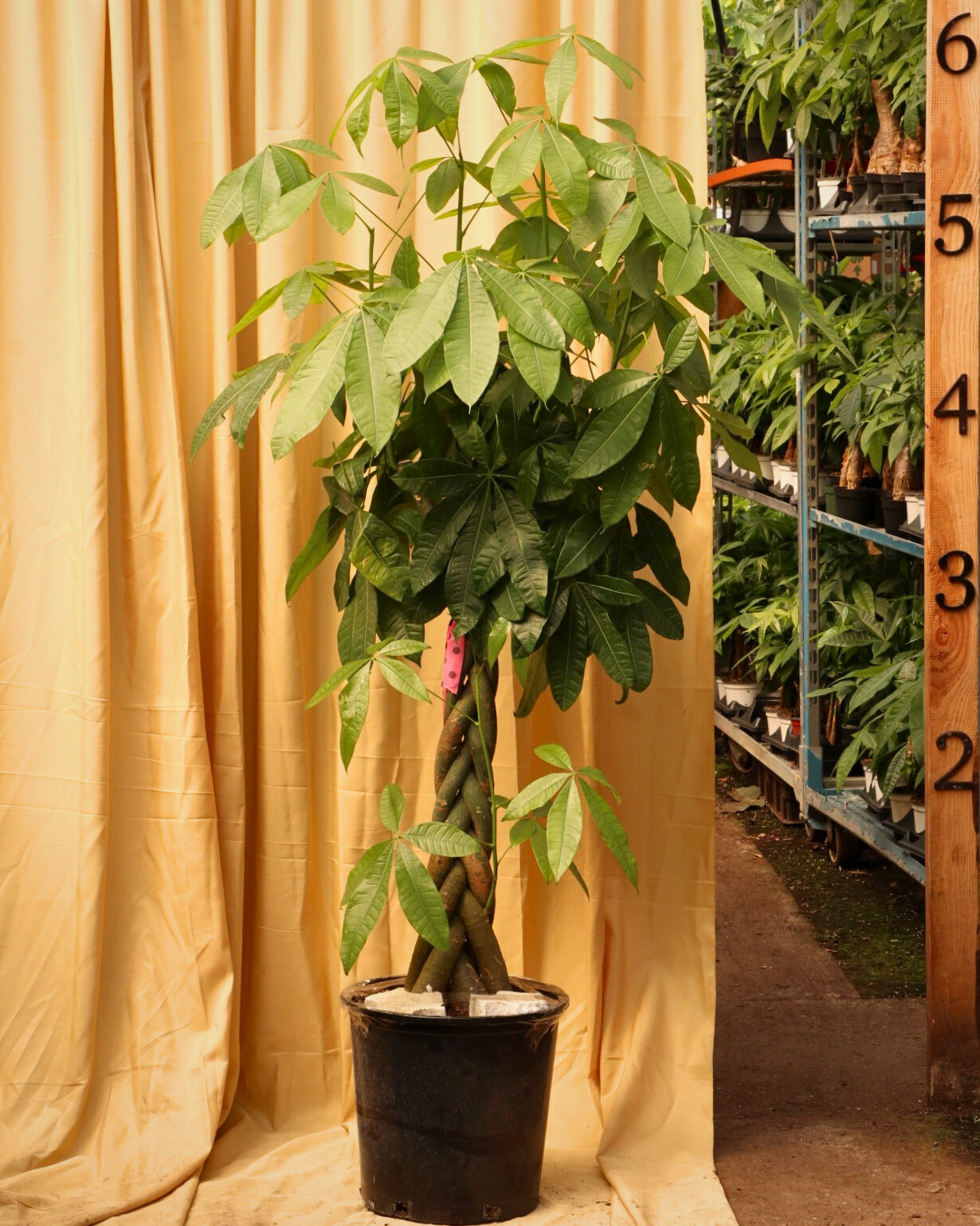
plant money tree outside Full Size Money Tree
SKU: 93217283370
plant money tree outside

plant money tree outside Full Size Money Tree

Sale price$20.12 Regular price$22.35
Save 10%

Pay in installments of $5.59 with ShopPay, AfterPay and Klarna

Shipping Estimate
USA
  • USA
  • CAN

Ships within 48 hours · Estimated delivery Jul 4 - Jul 9

Promo Codes Available:

For Your Every Summer RSVP, with Code: SUMMER15

Description

plant money tree outside Full Size Money TreeIf youre looking for good luckand a large houseplantthen look no further. Mr. Money Trees beautifully braided, swirling trunk traps good fortune. Not just good luck, but also a good income. Its leaves grow in groups of six, possibly representing six figures. Plus, the whole thing just looks striking. Money Tree benefits Some say a Money Tree can even promote healthier sleep, reduce stress, and decrease conflict in the home. We cant confirm the science

If you’re looking for good luck—and a large houseplant—then look no further. Mr. Money Tree’s beautifully braided, swirling trunk traps good fortune. Not just good luck, but also a good income. Its leaves grow in groups of six, possibly representing six figures. Plus, the whole thing just looks striking.


Money Tree benefits

Some say a Money Tree can even promote healthier sleep, reduce stress, and decrease conflict in the home. We can’t confirm the science behind those beliefs, but research does suggest that the Money Tree is an effective air purifier.


Place this adorable plant beside your bed at night, and take a deep breath. You just might sleep better and feel at ease, and you’ll definitely be breathing in cleaner air!


The Money tree looks cool

Scientifically known as the Pachira Aquatica, the Money Tree is a wetland plant native to Central and South America. Each “Money tree” is actually made up of multiple Pachira Aquaticas, gently hand woven together as they grow to maturity. Thanks to the Money Tree’s umbrella-like foliage, the plant’s swirling trunks look like they’re dancing in the rain, adding whimsy and romance to your indoor garden.


The Money Tree is pet-friendly and non-toxic

Money Trees are non-toxic to cats and dogs. We can’t stop your pet from nibbling on your precious Money Tree, but it won’t end in their demise. (We’ll send all the good vibes to your devoured Money Tree, though).


Lighting

Money Trees love low-light spots, even really low light, and they’ll bring you joyful thoughts even from a shady corner—or in bright indirect light. Money can’t buy happiness, but it can buy plants, which is almost the same thing?


Watering

Most houseplants can’t tolerate much trial and error when it comes to watering. But the Money tree is flexible! Money trees kinda like damp soil (they’re native to swampland after all), so overenthusiastic watering generally won’t kill them.


Pick your exact Money tree 


Now that you're an expert with the Money Tree, order this plant by 7pm ET to get this plant shipped out of our greenhouse in New Jersey tomorrow. (Wondering when it will arrive? Check with the zip code validator on top of the “Add To Cart” button.) We’ll deliver your Money Tree in our sustainable, super-secure packaging system, no matter where you live in the U.S. Your plants will arrive safe and intact!


Hop on a video call to select your Money Tree, and we WILL send out the EXACT plant that you picked out, just like if you picked it up at a local nursery or garden center. Except we have more and fresher plants to choose from, and you can't find our PAFE fine ceramic planter options anywhere other than our website. :)


For any other questions or concerns, please don't hesitate to reach out to us at [email protected] or call/text (609)-968-7063! Or if you want to learn more about the Money Tree, keep scrolling!


Money tree benefits


What is a Money tree good for?

The Money tree looks awesome, purifies the air, brightens your home, and—maybe—brings good fortune. That’s a legend, but nobody said legends can’t be based on truth! You should probably test it out, to be on the safe side.


Does the Money tree clean the air or give oxygen?

The Money tree cleans carbon dioxide from the air and replaces it with nice fresh oxygen for us to breathe. It also sucks up chemicals like formaldehyde and benzene, plus other synthetic chemicals from cleaning products, leaving the air cleaner.


Are Money trees easy to keep alive?

Money trees are very low maintenance. They’re not too fussy about their watering schedules or their lighting. However, everyone has something, and Money trees do prefer a narrow range of temperatures (65-75). They also want some humidity. But that’s all.


Money tree care


How often should I water my Money tree?

Water your Money tree every week or two—more often during the spring and summer, and less often in the fall and winter. The Money tree tolerates overwatering better than underwatering, but make sure you’re using well-draining soil.


How do I keep my Money tree happy?

It’s pretty easy to keep a Money tree happy! Water every week or two. Put it anywhere indoors except in direct sun. And sing it a lullaby every night at bedtime. Even easy-care plants don’t mind a little pampering.


Where should a Money tree be placed in the house?

Most importantly, place the Money tree wherever it can get the right lighting—anywhere from bright indirect light to truly low light. But traditionally, for the best luck, the Money Tree is placed in the southeast section of your home.


Do I need to fertilize my Money tree?

Fertilize your Money tree once a month during spring and summer, when it’s really growing. You can use a general-purpose fertilizer—it’s not a picky eater—but dilute it to half-strength and make sure the soil is wet before applying.


What temperature do Money trees like?

The Money tree is a bit fussy, liking a narrow range of indoor temperatures: 65 to 75 degrees. So keep your home at moderate temps year-round. (Finally, you can tell your spouse or Dad to turn up the heat.)


Can Money trees grow without sunlight?

Money trees can live happily in a dark room with little natural light. So if you have a room with teeny tiny windows, or your neighbor’s way-too-close apartment blocks the sun always, it’s ok—Mr. Money tree will be fine.


Should I spray water on my Money tree?

The Money tree does enjoy humidity, and its leaves will get crinkly in low humidity. However, there’s some debate over whether misting helps or not. To be on the safe side, if you live in low humidity, get a humidifier.


Money tree factoids


Why does the Money tree have 6 leaves?

Some say the six leaves symbolize six figures—in other words, the luck from the Money tree might lead to your next promotion. (It’s us, we’re the ones who say that.) No promises, but work really hard just in case.


What is the superstition about Money trees?

Legend says that having a Money tree in your home will bring good luck and possibly even financial fortune. We prefer “legend” over “superstition” because it sounds fancier and makes us look cooler for believing in it.


Is there a difference between a Money tree and a Money plant?

Yes, the Money tree and the Money plant are totally different species. The Money tree is officially Pachira Aquatica, and the most common money plant, the Chinese Money plant, is Pilea Peperomioides—and it’s a small plant, not a tree.


Is the Money tree good for feng shui?

The Money tree is powerful and meaningful in feng shui, especially if you place it in the southeast area of your home. It symbolizes personal and professional growth and is said to bring good fortune to you and your family.


Do Money trees bloom?

In the wild, Money trees often boast glorious fluffy orange blossoms. But that only happens because they’re pollinated by bats. Assuming you don’t keep any bats inside (weirdo), your Money tree is very unlikely to bloom indoors.


How often do Money trees grow money?

Sadly, the legend that Money trees bring wealth and fortune is more of a metaphor than a practical promise. None of our Money trees have ever grown cash, and if they start, we won’t sell them to you anymore!


Why is it called a Money tree?

The Money tree gets its name from the legend, myth, or superstition that it brings financial luck to its owner or household. However, it’s not literal; Money trees don’t grow money (and no one will pay you to own one).


How long do Money trees live indoors?

Even indoors, a Money tree can live ten years or even longer. Of course, it requires TLC, but it’s an easy-care plant so that’s not a tall order. The Money tree will be your botanical companion for a decade.

Shipping Notes
  • Free Standard Shipping on $100+ Orders to the USA.
  • Except Preorder products are shipped in 48 hours.
  • Delivery to the USA:
  1. Standard Shipping : 3-10 business days
  • If time is of the essence, please consider selecting expedited delivery for faster service.
Exchange/Return Notes
  • We offer a 30-day return/exchange service after receiving.
  • Final sale items are not eligible for returns or exchanges.
  • To process your return/exchange, please contact us at [email protected]
  • Please click here for more details>>> Return & Exchange Policy
SKU: 93217283370

Discover Niche Categories That Outsell plant money tree outside

Top-Converting Item to Boost Your Average Order

4.6 ★★★★★
Based on 103 reviews
Sort
Highest Rating
Newest First
Oldest First
Product Reviews
S
Verified Purchase
Susan Lane
Carnegie, US
★★★★★ 5
A well-written but perhaps too late warning
Format: Kindle
I wavered between 4 stars or 5 but ended up with 5 despite some reservations. The author has put a great deal of work into this book, which includes interviews with and intriguing anecdotes about most of the leading figures in the AI revolution. I did not know, for example, that the term “singularity” was coined as an analogy to the event horizon of a black hole – the point beyond which we cannot see the future. This is not the deepest or most technical book on this topic: that award goes to Nick Bostrom’s Superintelligence. It also ignores the short to medium term issue posed by even sub-human AI -- the millions of job losses (hundreds of millions globally) likely to occur in the next 10 to 20 years. It focuses instead on the risks of super-intelligent AI, AI that exceeds – soon by orders of magnitude – human level intelligence. It is nevertheless a superb book for its intended purpose: raising public awareness of the existential risk posed by this development. AI, the author says, is the cuckoo chick in the nest. The AI community built the nest and is now busily feeding this strange chick. Mesmerized by its open mouth, they ignore the mortal danger it poses to their own progeny. Even when they know what will happen in the end, they cannot quite believe it. Only intervention by the non-technical public has any chance at all of short circuiting this process. Against these many good points, I would have liked to hear the author’s take on what I think is the critical question overlooked both by Kurzweilian optimists and AI skeptics. Both the notion that we will somehow “merge” with AI and the notion that AI will eat us alive depend on the assumption that silicon-based intelligence can have conscious awareness. We certainly wouldn’t want to merge with anything that would result in our becoming permanently unconscious, and Barrat repeatedly assumes that AI will be “self-aware,” a state that first requires being “aware,” that is phenomenally conscious. The unasked question is whether AI, as it is currently being developed, can have that capacity. IBM’s Watson may be good at Jeopardy but there is no reason to believe that it knows it is good at Jeopardy, or feels good at being good at it. By contrast, honey bees appear to become depressed when they are shaken. This suggests that there is something fundamentally wrong about the notion that current AI, as it becomes more intelligent, will “automatically” become conscious. The best current theory of consciousness – integrated intelligence theory – suggests that a computer can become conscious but only if it is wired very differently from the ones we currently have. Nevertheless, this is still an excellent book, so in the end I thought the 5 star rating was deserved.
WAS THIS REVIEW HELPFUL?YesReportShare
Reviewed in the United States on June 14, 2015
K
Verified Purchase
Ken Silber
San Leandro, US
★★★★★ 4
Thought-provoking though not always convincing
Format: Hardcover
I originally posted a version of this review on my blog Quicksilber and am posting it here as well as I think the book merits broad notice: In a small irony, my writing about James Barrat's Our Final Invention has been slowed by a balky Internet connection. In my experience, glitches have become considerably more common as computers have become more powerful and complicated. Perhaps such growing glitchiness suggests artificial general intelligence (AGI) and artificial superintelligence (ASI) are more likely to get seriously out of control someday, though it might also be a hint that AGI and ASI are going to be harder to achieve than expected by either techno-optimists such as Ray Kurzweil or techno-pessimists such as James Barrat. Barrat's goal in this book is to convince readers that AGI and ASI are likely to occur in the near future (the next couple of decades or so) and, more to the point, likely to be extremely dangerous. In fact, he repeatedly expresses doubt as to whether humanity is going to survive its imminent encounter with a higher intelligence. I find him more convincing in arguing that ASI would carry significant risks than I do in his take on its feasibility and imminence. Barrat aptly points out that building safeguards into AI is a poorly developed area of research (and something few technologists have seen as a priority); that there are strong incentives in national and corporate competition to develop AI quickly rather than safely; and that much relevant research is weapons-related and distinctly not aimed at ensuring the systems will be harmless to humans. The book becomes less convincing when it hypes current or prospective advances and downplays the challenges and uncertainties of actually constructing an AGI, let alone an ASI. (Barrat suggests that once you get AGI, it will quickly morph into ASI, which may or may not be true.) For instance, in one passage, after acknowledging that "brute force" techniques have not replicated everything the human brain does, he states: >>But consider a few of the complex systems today's supercomputers routinely model: weather systems, 3-D nuclear detonations, and molecular dynamics for manufacturing. Does the human brain contain a similar magnitude of complexity, or an order of magnitude higher? According to all indications, it's in the same ballpark.<< Me: To model something and to reproduce it are not the same thing. Simulating weather or nuclear detonations is not equal to creating those real-world phenomena, and similarly a computer containing a detailed model of the brain would not necessarily be thinking like a brain or acting on its thoughts. A big problem for AI, and one that gets little notice in this book, is that nobody has any idea how to program conscious awareness into a machine. That doesn't mean it can never be done, but it does raise doubts about assertions that it will or must occur as more complex circuits get laid down on chips in coming decades. Barrat often refers to AGIs and ASIs as "self aware" and his concerns center on such systems, having awakened, deciding that they have other objectives than the ones humans have programmed into them. One can imagine unconscious "intelligent" agents causing many problems (through glitches or relentless pursuit of some ill-considered programmed objective) but plotting against humanity seems like a job for an entity that knows that it and humans both exist. Interestingly, though, Barrat offers the following dark scenario and sliver of hope: >>I think our Waterloo lies in the foreseeable future, in the AI of tomorrow and the nascent AGI due out in the next decade or two. Our survival, if it is possible, may depend on, among other things, developing AGI with something akin to consciousness and human understanding, even friendliness, built in. That would require, at a minimum, understanding intelligent machines in a fine-grained way, so there'd be no surprises.<< Me: Note that some AI experts, such as Jeff Hawkins, have argued the opposite--that the very lack of human-like desires, such as for power and status, is why AI systems won't turn against their makers. It would be a not-so-small irony if efforts to make AIs more like us make them more dangerous. Our Final Invention is a thought-provoking and valuable book. Even if its alarmism is overstated, as I suspect and hope, there is no denying that the subject Barrat addresses is one in which there is very little that can be said with confidence, and in which the consequences of being wrong are very high indeed.
WAS THIS REVIEW HELPFUL?YesReportShare
Reviewed in the United States on January 14, 2014
D
Verified Purchase
daveyd
Lexington, US
★★★★★ 5
all driven by artificial super intelligence (ASI)
Format: Hardcover
You are peering inside a black hole at a "point" beyond which you cannot see and where no one knows what exists. The point represents a period of time technologically known as Singularity. Even light cannot escape from the point and on the other side it is known only that there is a profound self replicating intelligence greater than our own, all driven by artificial super intelligence (ASI). Physicist Stephen Hawking writes that "In contrast with our intellect, computers double their performance every eighteen months. So the danger is real that they could develop intelligence and take over the world". Computer scientist and professor Vernon Vinge writes that "Within 30 years, we will have the technological means to create super human intelligence. Shortly after the human era will be ended". Our Final Invention is 267 pages of authoritative manuscript that is compelling, fascinating and beyond the fright stage. The book's author on numerous occasions refers to "we" as if there exists a unified collective engaged in artificial general intelligence(AGI) or artificial super intelligence (ASI). The reality is that some 56 nations are currently in different stages of arcane artificial intelligence designs. They include antagonists such as North Korea, Iran and suicide regimes from the Middle East. Russia, China and the U.S. are the biggest players as is Israel. The author believes that super computers fueled by nanotechnology will combine to produce ASI trillions of times more powerful than any human academic or intellectual resources. ASI has the potential to eliminate hunger, poverty, disease and even mortality but disruptions of global economies and politics will be in evidence as balance of powers are shifted. Unemployment dynamics will infect bank tellers, retail clerks, travel agents, loan officers stock brokers.... Computer software designs are so complex, even incomprehensible, that failures are inevitable. The 1986 Chernobyl meltdown, Three Mile Island, and Fukushima were all designed by highly qualified professionals but with complex infrastructures. Under Singularity as computer speeds double with frequency while human intelligence is unchanged, perhaps the musings of Hawking and Vinge will prove to be prescient. Our Final Invention is 267 pages of a very dark subject which not even a trace of a happy Betty Grable ending is to be found. My time has expired. Perhaps the final words were well expressed by Jaan Tallin, cofounder of Skype: 'A hard-hitting book about the most important topic of this century and possibly beyond---the issue of whether our species can survive. I wish it was science fiction but I know it's not'!
WAS THIS REVIEW HELPFUL?YesReportShare
Reviewed in the United States on January 23, 2016
J
Verified Purchase
Jacob Donkin
Port Orchard, US
★★★★★ 5
Gripping and Informative, a Must-read
Format: Hardcover
As someone who struggles to finish books in their entirety, I found Our Final Invention by James Barrat highly readable, deeply informative, and utterly gripping. The book contains a powerful message: through competition, distrust, desire and curiosity, humans will inevitably create an artificial intelligence (AI) that rivals or surpasses our own. Thus, it is wise and necessary to invest now in mitigation efforts and potential safeguards -- increased research and advocacy for AI risk and, most importantly, producing friendly AI. Barrat covers a lot of ground, but his main argument is summarized as follows: Currently, we humans regularly utilize narrow AI technology (technology capable of achieving specific, programmed goals through unassisted human computing -- Siri, Google search, IBM's Watson, etc). We are also experimenting with "black box" tools and techniques (programs where inputs and outputs are understood and measurable, but the processes in between aren't -- genetic algorithms/programming and software that writes better software) and artificial neural networking (ANN), as seen through efforts to reverse engineer the human brain. And, below the surface, there is an ongoing race between world powers (driven mainly by national security, defense, and international business interests) and guided by AI developers to develop and achieve artificial general intelligence (AGI) -- human-level artificial intelligence. The problem is that once AGI is achieved it will be very difficult to manage, and may very well result in the manifestation of artificial super intelligence (ASI) -- greater than human-level intelligence. ASI could theoretically become thousands of times smarter than the smartest human being alive. It won't think like us, won't want to be ruled by us, and, most crucially, it won't want to be turned off. In fact, ASI would likely regard us as potential fuel for its quest to duplicate and improve itself exponentially in order to achieve its goals. Throughout the book, Barrat refers to interesting psychological phenomena and concepts (such as the normalcy bias), while drawing on personal experiences, historic events, and interviews with computer programmers, inventors and philosophers, to tactfully illustrate how progress in AI development is dangerously rapid. Adequate checks and balances are not in place to deal with a non-ideal intelligence explosion or hard take-off (AGI quickly leading to ASI). I highly recommend this book to anyone interested in learning about both human beings and the advancement of machines. I suspect that the prominence of AI, as a research field and topic for discussion, will only increase in time (it already has in recent years -- drones, smart technology, Wall Street high frequency trading (HFT), financial modeling), making Our Final Invention a valuable guide or stepping stone for anyone trying to understand our world and the path of the future.
WAS THIS REVIEW HELPFUL?YesReportShare
Reviewed in the United States on July 3, 2014
A
Verified Purchase
Ashley Sutton
Fort Morgan, US
★★★★★ 5
Great book
Format: Hardcover
We love the FGTEEV books!
WAS THIS REVIEW HELPFUL?YesReportShare
Reviewed in the United States on May 31, 2026

recommand products